

Trading_desk_with_monitors_202606091724

Options Trading 101: A Beginner’s Guide to Calls and Puts

What is Options Trading? Options are derivative contracts that give you the right, but not the obligation, to buy or sell an underlying asset (like a stock or an index like Nifty/BankNifty) at a specific price on or before a certain date. They are highly leveraged instruments, meaning they can offer massive returns, but they also carry a high risk of capital wipeout.

The Two Basic Types of Options:

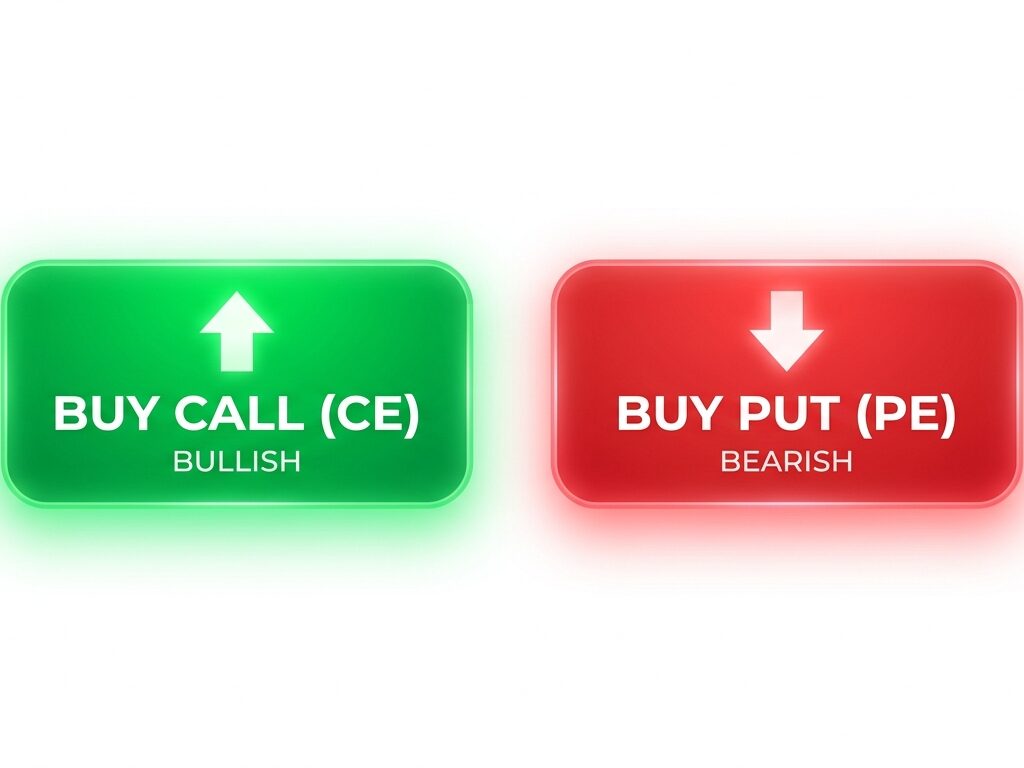
  • Call Options (CE): You buy a Call option when you are bullish and expect the market price to go up. If the underlying asset’s price rises above your strike price, your Call option increases in value.
  • Put Options (PE): You buy a Put option when you are bearish and expect the market price to go down. If the underlying asset’s price falls below your strike price, your Put option increases in value.

Crucial Concepts to Understand:

  • Strike Price: The pre-agreed price at which the option contract can be exercised.
  • Expiry Date: All options contracts have a lifespan. In India, index options expire weekly (e.g., Thursdays for Nifty) and monthly. After expiry, out-of-the-money options become worthless (zero).
  • Premium: The price you pay to the option seller to buy the contract. This is your maximum risk as an option buyer.
A Word of Caution (Fact-Based) According to SEBI data, 9 out of 10 individual traders in the equity F&O (Futures & Options) segment incur net losses. Before buying your first Call or Put, spend time learning about ‘Option Greeks’ (Delta, Theta) and how time decay affects option premiums.


Global_capital_flow_stock_market_202606031908

The Secret to Finding the Strongest Stocks Before the Crowds

Ever noticed how in some months, every IT stock seems to double, while in others, they all crash together? You might hold a great company, but its stock price just won’t move. Why? The answer lies in Sector Rotation.

To achieve massive profits consistently, you cannot just pick one good stock and sit on it forever. Smart money (institutional investors) doesn’t trade individual stocks as much as they trade entire sectors.

What is Sector Rotation? In simple terms, Sector Rotation is the systematic movement of institutional capital from one industry group (like Pharma, IT, Auto) to another, driven by where the economy is in its current business cycle (Recovery, Growth, Recession).

When big mutual funds and FIIs decide to buy, they don’t buy 500 different stocks. They identify which sector will outperform in the next 6-12 months and pour billions into those specific ETFs or large-cap stocks. Retail traders who understand this can get in on the ground floor before the general public notices.

How the Economic Cycle Drives Rotation:

The economy moves in a predictable cycle, and specific sectors perform better at different stages:

  1. Early Bull Market (Economic Bottom): As the economy starts recovering (usually with low-interest rates), capital rotates into highly cyclical and debt-sensitive sectors like Banking (BFSI), Real Estate, and Auto.
  2. Mid-Bull Market (Peak Growth): GDP is strong. Technology, Industrial Manufacturing, and Consumer Discretionary (goods people buy when they have extra money, like luxury items or new cars) flourish during this time.
  3. Late Bull Market (Economy Overheating): Inflation starts to rise. Money flows into resources and commodities: Energy (Oil/Gas) and Materials (Metals like Steel).
  4. Bear Market (Recession): Investors get defensive. They shift capital out of growth and cyclical stocks into “Recession-Proof” sectors that provide necessities: Pharma, FMCG, and Utilities.

How to Implement Sector Rotation as a Trader:

  • 1. Use Relative Strength (NOT RSI): Compare sector indices (e.g., Nifty Bank, CNX IT) against the main index (Nifty 50 or S&P 500). You are looking for sectors making higher highs while the main index is flat or making lower highs.
  • 2. Watch Interest Rates: Interest rate decisions are the single biggest trigger for rotation. Falling rates fuel cyclical growth; rising rates boost the cost of capital, often starting a rotation into defensive sectors.
  • 3. Follow the “Golden Crossover” Niche: The Abundance blueprint teaches you exactly how to identify these macro shifts through both technical chart confluences and fundamental triggers, giving you a structured approach to follow the big money, not predict it.

Conclusion

By mastering sector rotation, you align yourself with the macro flow of the entire stock market. You stop swimming against the current and start riding the biggest waves. Remember: a rising tide lifts all boats, but only if you are already sitting in the right boat.